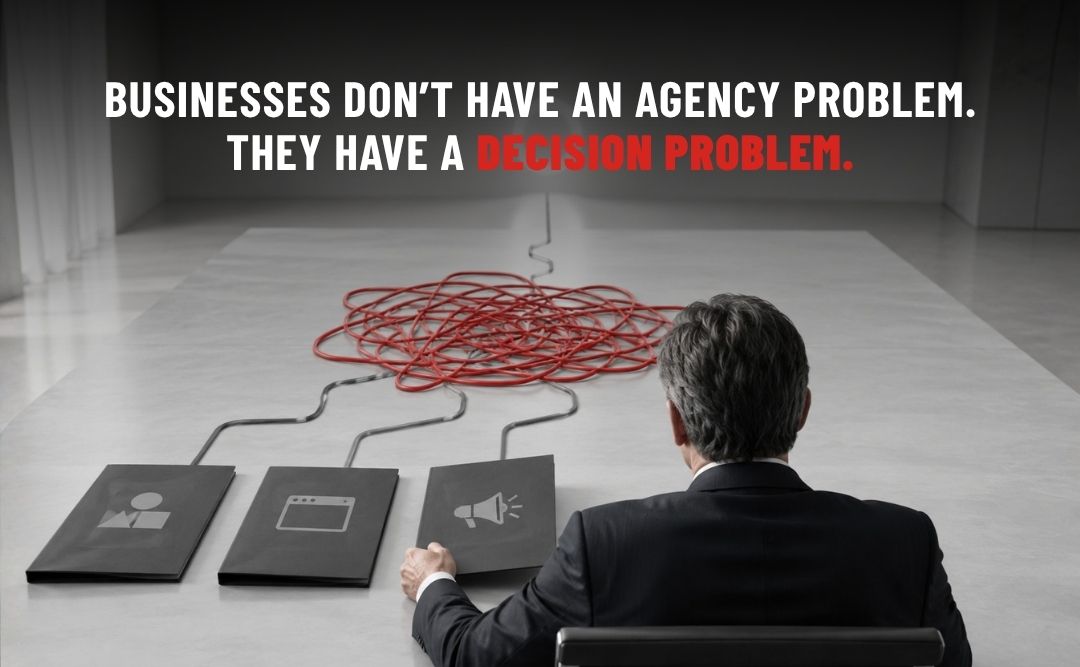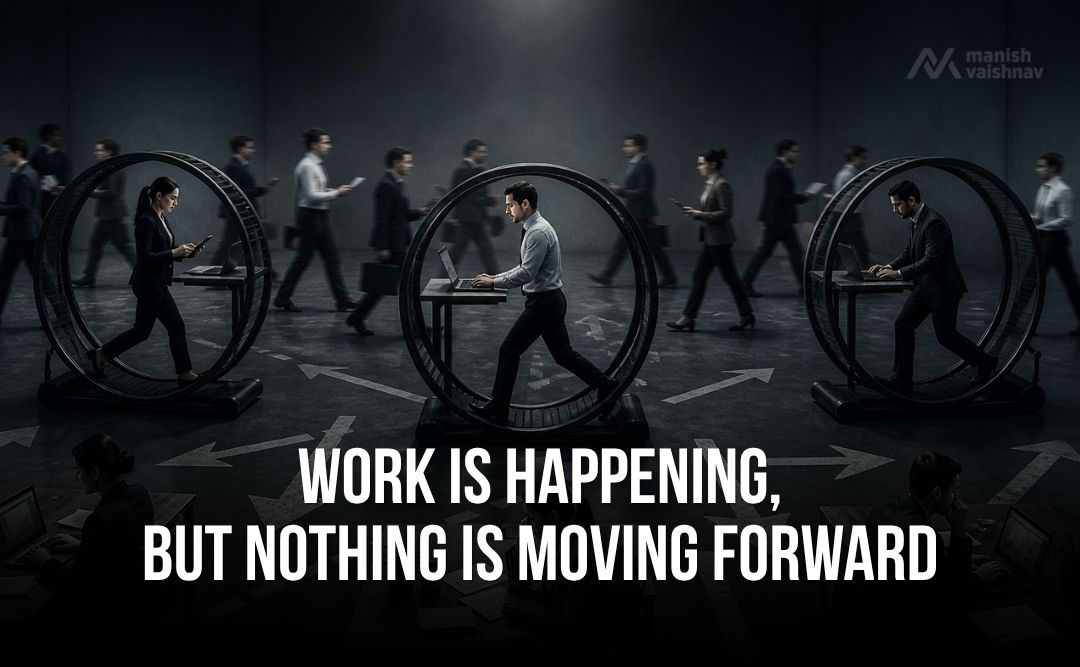
Businesses Don’t Have an Agency Problem. They Have a Decision Problem.
Most businesses change agencies before clearly defining the problem they expect the new agency to solve. Better execution begins with better decisions not simply a different supplier.

Every Agency Change Begins with the Same Hope
One of the most common conversations I have with business owners begins with a familiar statement.
Sometimes it is a branding agency.
Sometimes a website company.
Sometimes a digital marketing agency.
Sometimes a technology partner.
The names change.
The conversation doesn't.
Most people expect my next question to be:
Instead, I usually ask something else.
For a few moments...
The room becomes quiet.
Not because they don't know their business.
But because they have never separated the problem from the solution.
Hiring a new agency is a solution.
The real question is...
What is the actual business problem?
Until that answer becomes clear, changing agencies often changes very little.
The Agency Isn't Always the Problem
Businesses usually replace agencies for understandable reasons.
- "We aren't getting enough enquiries."
- "Our website feels outdated."
- "Our brand looks old."
- "Digital marketing isn't delivering results."
- "Customers don't understand what we do."
These are genuine concerns.
But are they the real problems?
Or are they simply symptoms of something deeper?
Imagine visiting a doctor with a persistent headache.
A painkiller may reduce the discomfort.
But if the headache is caused by poor eyesight, stress or high blood pressure, the pain will return.
The symptom changes.
The cause remains.
Business works in much the same way.
A new agency may improve execution.


Businesses Often Replace the Supplier Instead of Solving the Problem
During consulting assignments, I have noticed a recurring pattern.
A company changes its branding agency.
Six months later...
It changes its website agency.
A year later...
It appoints a new digital marketing company.
Then a new SEO partner.
Then a CRM consultant.
Then a software vendor.
Every change is made with genuine optimism.
Sometimes they do.
Often they don't.
Because the agency changed...
The thinking behind the brief didn't.
The new agency receives the same business objectives.
The same assumptions.
The same unclear positioning.
The same internal confusion.
Naturally...
The results look surprisingly similar.
Different agency.
Same business thinking.
Same outcome.
Symptoms Are Often Mistaken for Problems
One of the most expensive mistakes businesses make is treating symptoms as problems.
Consider these examples.
Sales are declining.
The response?
Hire a new marketing agency.
But what if the real issue is weak positioning?
Customers compare only on price.
The response?
Redesign the brochure.
But what if the real issue is that the business has never clearly communicated its value?
Website enquiries are low.
The response?
Build a new website.
But what if the website accurately reflects a message that was never clear in the first place?
The brand feels outdated.
The response?
Design a new logo.
But what if customers already trust the existing brand—and the real issue is inconsistent communication?
Replacing the agency often feels like progress.
Understanding the problem usually creates progress.The two are not always the same.

Better Execution Cannot Fix the Wrong Decision
This is perhaps the most important lesson I have learned over the years.
Execution multiplies decisions.
It rarely corrects them.
- A better designer cannot fix unclear positioning.
- A better developer cannot fix an unclear customer journey.
- A better advertising agency cannot fix the wrong target audience.
- A better software implementation cannot fix a broken business process.
Nor can artificial intelligence compensate for unclear business thinking.
Every specialist improves execution within their area of expertise.
But someone still has to decide what should be executed and why.
That responsibility belongs to business leadership.
Not the agency.
Every Agency Works from the Brief It Receives
Businesses often evaluate agencies based on the quality of the final output.
That is fair.
But there is another question worth asking.
Was the agency given the right brief?
An outstanding creative team working from an unclear brief will still struggle to produce meaningful work.
A marketing campaign cannot communicate a value proposition that has never been defined.
A website cannot explain a business strategy that does not exist.
A company profile cannot create clarity if leadership itself has not reached clarity.
Sometimes the work delivered by an agency reflects the quality of the brief more than the capability of the people creating it.
That is why improving the brief often produces better results than changing the agency.
Before Replacing Your Agency, Pause for a Moment
Before beginning the search for another agency, consider asking a different set of questions.
Not...
But...
What business problem are we actually trying to solve?
How will we know if the problem has been solved?
Is the issue strategic or operational?
Have we clearly communicated our expectations?
Does everyone within the leadership team define success in the same way?
The answers to these questions often determine whether changing the agency is necessary...
or whether the business simply needs greater clarity before moving forward.

Sometimes the Agency Should Be Changed
This article is not an argument against agencies.
In fact, many agencies do exceptional work.
Some become long-term growth partners.
Others consistently deliver outstanding creative thinking, technology, communication and execution.
The question is not whether agencies create value.
They do.
The real question is whether they have been given the right problem to solve.
There are situations where changing an agency is absolutely the right decision.
For example:
- The agency no longer understands your business.
- Communication has broken down.
- Deadlines are repeatedly missed.
- Execution quality has declined.
- Trust no longer exists.
- The agency has outgrown your business—or your business has outgrown the agency.
In these situations, replacing the agency is a sensible business decision.
But changing an agency should be the conclusion of a diagnosis.
Not the starting point.
Agencies Execute. Leaders Decide.
One observation has remained consistent throughout my consulting journey.
Businesses often expect agencies to solve problems that actually belong to leadership.
Agencies Execute
An agency can design a better website.
An agency can create a compelling company profile.
An agency can improve digital marketing.
An agency can develop a strong brand identity.
Leaders Decide
It cannot decide what your business should stand for.
It cannot define your long-term business direction.
It cannot decide which market your business should focus on.
It cannot replace business clarity.
Execution is a specialised skill.
Decision-making is a leadership responsibility.
The strongest business relationships exist when both understand their roles.

The Most Valuable Brief Is Business Clarity
Many businesses spend weeks preparing a Request for Proposal (RFP).
Very few spend the same amount of time preparing a clear business brief.
Yet the brief determines everything that follows.
A weak brief often produces:
- Multiple revisions.
- Conflicting opinions.
- Delayed approvals.
- Disappointed expectations.
- Budget overruns.
- Frustration for both the client and the agency.
A clear brief creates something entirely different.
It creates alignment.
When everyone understands the objective, decisions become faster.
Communication becomes simpler.
Execution becomes more focused.
The final outcome usually improves—not because the agency changed, but because clarity improved.
Before You Replace Your Agency, Ask These Questions
The next time someone in a meeting says,
Pause for a moment.
Ask these questions first.
Business
- What business problem are we trying to solve?
- Is this problem new or has it existed for years?
- Are we treating the cause or the symptom?
Strategy
- Has our business strategy changed?
- Has our positioning changed?
- Are we communicating the right value to the right audience?
Execution
- Was the agency given a clear brief?
- Were expectations clearly defined?
- Did we measure outcomes—or only activities?
Leadership
- Does the leadership team agree on success?
- Would another agency receive a different brief?
- If nothing changes internally, why would we expect different results externally?
Sometimes these questions reveal that the agency is the issue.
More often, they reveal something far more valuable.
Clarity Reduces Expensive Decisions
Business leaders often ask me,
My response is usually different.
I first try to understand whether hiring another agency is actually the right decision.
Because hiring the wrong agency costs money.
Hiring the right agency for the wrong objective costs even more.
It consumes time.
Creates frustration.
Reduces confidence.
And often leads to another agency search a year later.
The most expensive business decisions are rarely expensive because of their cost.
They become expensive because they move the business in the wrong direction.

Reflection Questions
Before changing your agency, ask yourself:
If these questions are difficult to answer...
Leadership Checklist
Before deciding to replace your agency, ensure you can answer Yes to these questions.
- We have clearly identified the business problem.
- We know the outcome we expect.
- Our brief is clear and measurable.
- Leadership agrees on priorities.
- We have evaluated whether the issue is strategic or operational.
- We have discussed the problem before discussing suppliers.
- We are changing agencies for the right reason—not simply because results are disappointing.

A Consultant's Perspective
One of the most common patterns I observe is not poor agency performance.
It is businesses repeatedly changing execution partners while leaving the original business decisions unchanged.
A different agency receives the same unclear brief.
The same assumptions.
The same expectations.
The same internal confusion.
The outcome changes only slightly.
Not because the agency lacks capability.
But because clarity never improved.
In my experience, businesses achieve better long-term results when they invest time in defining the problem before selecting the people who will solve it.
Execution improves businesses.
Clear thinking improves decisions.
And better decisions give execution a far greater chance of succeeding.
One Final Thought
Changing an agency may improve execution.
Changing your business thinking may improve the business itself.
Knowing the difference is one of the most valuable decisions a leadership team can make.
Because the quality of your agency certainly matters.
But the quality of the decisions you ask them to execute matters even more.
Great agencies execute great ideas. Great businesses begin with great decisions.
Consultant's Note
Businesses rarely fail because they lack talented agencies.
More often, they struggle because the business problem has never been clearly defined.
Before changing partners, take time to define the challenge, align the leadership team and clarify the outcome you want to achieve.
Sometimes the most valuable investment isn't a new agency.
It's a better conversation before appointing one.
Our Recent Blogs :