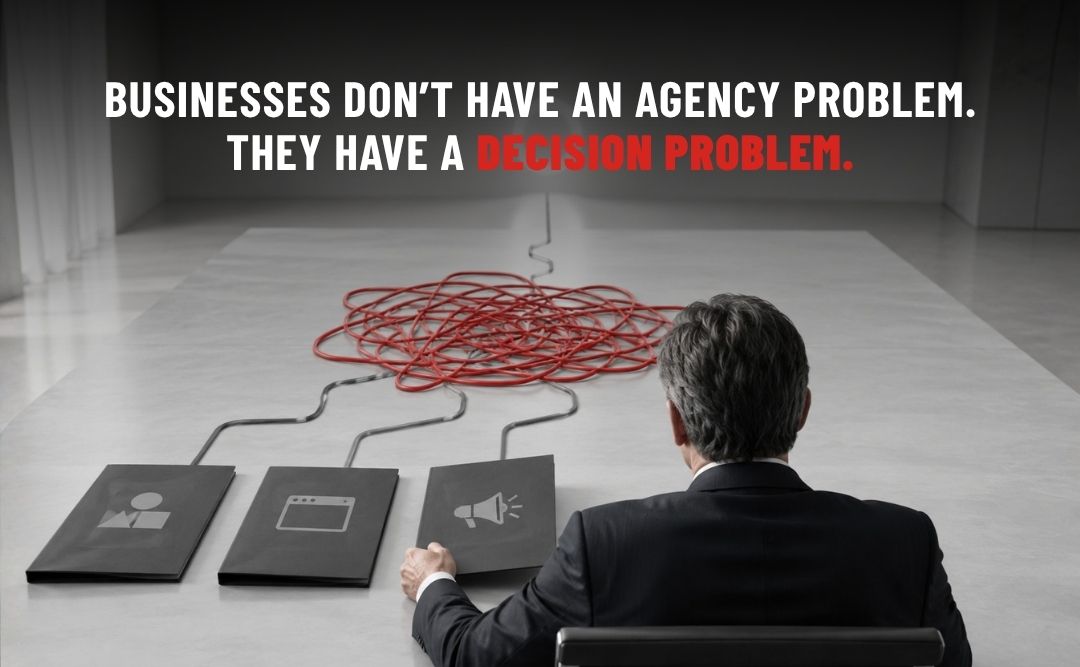
Your Team Is Not Slow. You May Be Making Them Work Twice.
If your team is always busy but deadlines still slip, the problem may not be productivity. Changing priorities, unclear ownership and reopened decisions could be consuming more capacity than you realise.

Everyone Is Busy. So Why Does Everything Still Take So Long?
The team is busy. Meetings are happening, emails are moving, WhatsApp groups are active and approvals are being taken. Some people may even be working beyond normal hours.
Yet projects still get delayed. Management begins asking, “Why is everything taking so long?”
The natural conclusion is that the team needs to become more productive. Perhaps people need to work faster, improve time management or use better software. Maybe another employee, agency or vendor is required.
Sometimes that diagnosis is correct. But sometimes the team is not working slowly. It is simply doing too much of the same work more than once.
The Work May Not Be Slow. The Finish Line May Be Moving.
Imagine a business assignment that begins on Monday. The brief is discussed, the team develops a direction, changes are suggested and the revised direction is approved. Execution begins.
On Wednesday, someone discovers an interesting reference. Another senior person suggests a different approach. By Thursday, the approved direction has changed and the team starts again.
On Friday, management sees one completed assignment and concludes that it took five days. But did it? The team may have completed significant portions of the same assignment two or three times. Management sees one deliverable, but the effort behind it tells a different story.
This distinction matters because asking people to work faster will not solve a problem created by repeatedly changing where they are supposed to go.

The Hidden Business Cost of Rework
Most businesses track visible costs reasonably well: salaries, software, infrastructure, agency fees, vendor bills and project timelines. But one cost rarely appears clearly in management reports: the cost of doing completed or partially completed work again.
A presentation is redesigned after approval. A proposal is rewritten because the objective changes. A campaign is recreated after a new reference appears. A quotation is prepared again because the requirements were incomplete. A software feature is rebuilt because the workflow was not understood before development.
None of these may appear in the accounts under a heading called Rework. But the business still pays for them through additional time, lost capacity, delayed delivery, management attention and missed opportunities.
The real cost is often what did not happen
Consider a hypothetical team of five people. If each person spends just one hour every working day on avoidable rework, the business loses 110 working hours over a 22-day month.
That is not necessarily 110 hours of recoverable cost. Some of those hours may involve unavoidable coordination or work that creates learning. But the example shows why even small, repeated inefficiencies deserve management attention.
The greater concern is what those hours could have produced instead: customer follow-ups, new business opportunities, process improvements, strategic thinking or progress on other projects.
When “Approved” Stops Meaning Approved
Approval is often treated as a small administrative step. Operationally, it should mean that sufficient thinking has happened for the next stage of work to proceed.
It does not mean a decision can never change. Business conditions evolve, customers provide new information, mistakes are discovered and better alternatives sometimes emerge. A responsible business should change direction when there is a genuine reason.
However, there is a difference between changing a decision because something meaningful has changed and reopening it because the thinking was incomplete before execution began.
Approved
Sufficient thinking has happened for the next stage of work to proceed.
Reopened
The direction changes again because the thinking was incomplete before execution began.
Hesitation
The team starts waiting, reconfirming and preparing unnecessary alternatives.
When an approved direction can casually change the next morning, the word approved gradually loses its meaning. The team begins waiting for reconfirmation, hesitating before committing and preparing unnecessary alternatives. People may even delay execution because experience has taught them that today’s decision may not survive until tomorrow.

Every new idea has an execution cost
A senior person may suggest, “Can we try another version?” The suggestion takes ten seconds, but the alternative may require four hours. Another person may forward a reference with the message, “Can we explore something like this?” Understanding the reference, reconsidering the direction, creating an alternative and presenting it may consume half a day.
Exploration is valuable. The problem begins when organisations treat every suggestion as if it has no execution cost.
This is particularly important when suggestions come from people with authority. What a senior person considers an idea may easily be interpreted by the team as an instruction.
Too Many Decision-Makers. Too Few Decision Owners.
Collaboration improves decisions when different perspectives are considered properly. Marketing understands customers. Sales understands objections. Operations understands feasibility. Finance understands cost. Leadership understands business priorities. External specialists contribute their expertise.
But input and decision authority are not the same thing. Problems begin when everyone can redirect the work, but nobody clearly owns the final decision.
Final Call.
Responsibility.
One person wants simplicity, another wants more information. One wants premium positioning, another wants aggressive communication. One wants to launch immediately, another wants three more options. Each opinion may be reasonable independently. Together, they can make execution extremely difficult.
The team is no longer solving only the original business problem. It is trying to satisfy multiple interpretations of that problem.
A decision owner is not necessarily the most senior person. It is the person who has clearly defined authority to consider inputs, make the final call and accept responsibility for the outcome. Without that clarity, organisations can have many decision-makers but very few decision owners.

Managers Should Reduce Complexity,
Not Add to It
As businesses grow, owners appoint managers so that every operational decision no longer needs their personal involvement. A good manager should reduce the decision load on both leadership and execution teams.
The role involves understanding inputs, evaluating priorities, resolving conflicts, considering operational realities and giving the team a direction it can act upon.
If every opinion received by a manager simply becomes another instruction for the team, the management layer has not reduced complexity. It has transferred it.
Similarly, when the owner gives one direction and the manager gives another, the team may be left wondering which instruction carries final authority. The owner may be right. The manager may be sincere. The team may be capable. Yet the working system can still create confusion.
Instead of asking who is wrong, leadership should examine how decisions move through the organisation. A well-defined management structure should make responsibilities clearer, decisions faster and execution more predictable, not merely introduce another approval stage.
Seven Signs Your Team May Be Working Twice
These familiar situations may indicate that avoidable rework is consuming business capacity.
“Final” work regularly comes back for another round. Final has become another stage in the process rather than a decision.
New references appear after approval. Useful suggestions arrive after the team has already invested time in the approved direction.
Different senior people give different directions. The team spends more time reconciling opinions than executing decisions.
People frequently ask, “Whose approval is final?” Decision ownership is unclear.
The brief becomes clearer only after execution begins. Important thinking is happening after time and resources have already been committed.
Completed work receives more discussion than the original objective. Attention moves from solving the problem to repeatedly modifying the output.
Management repeatedly asks, “Why is this taking so long?” But nobody examines how many times the work has restarted.
Rework Often Begins Before the Work Begins
A surprising amount of rework starts before anyone begins execution. The objective is not completely clear. The audience is loosely defined. Different stakeholders expect different outcomes. The decision-maker is uncertain and success has not been defined.
But execution begins anyway because starting feels productive. The designer starts designing, the marketing team creates content, the developer begins building and the salesperson prepares a proposal.
Only then do important questions emerge: What exactly are we trying to achieve? Who is this for? Which direction do we want? Who needs to approve it? Those questions were always there. They simply appeared after execution had already started.
A clear brief cannot eliminate every revision, nor should it. But it improves the likelihood that the first execution moves in the right direction.
Not all rework is waste
A prototype may require iteration. Creative work needs exploration. Testing may reveal something nobody could have known earlier. Customer feedback may justify a change, and an original assumption may prove wrong. In these situations, rework can be part of learning and improvement.
The objective should never be to create an organisation where nobody is allowed to change their mind. That would create a different problem.
The important distinction is between rework that creates learning or better outcomes and rework caused by avoidable confusion, unclear decisions or unnecessary repetition. The first may be an investment. The second quietly consumes capacity.
Before Asking Your Team to Work Faster
When businesses face a capacity problem, the first response is often to hire another person, add another vendor, extend the deadline, introduce software or ask employees to increase speed. Sometimes additional capacity is genuinely necessary. But first, examine how work moves through the organisation.
A Simple Framework to Reduce Rework
You do not necessarily need another software platform to begin. A simple review of projects over one month may reveal enough. How much time went into creating something new? How much went into correcting genuine mistakes? How much was spent repeating work because the direction changed?
Why Can a Busy Team Still Have Low Productivity?
A busy team can still have low productivity when a significant part of its capacity is spent redoing work because of unclear briefs, changing priorities, multiple decision-makers or approvals that repeatedly reopen completed tasks.
This is why activity and productivity should not be treated as the same thing. A busy office can look highly productive. Calls are happening, meetings are full, messages are constant and everyone appears occupied. But productivity should move work towards a useful outcome.
If work repeatedly moves forward and backward, activity may remain high while progress remains low. This becomes especially important as organisations grow. More employees create more interactions, more departments require coordination and more managers introduce decision points.
The answer is not necessarily fewer people or fewer opinions. It is a clearer way for decisions to become execution.
One Question Can Change the Productivity Discussion
The next time a project feels unusually slow, instead of asking, “Who is delaying this?”, try asking:
Then examine the original brief, the reasons for each change, who approved them and how much work had to be repeated. Was the change necessary? Could the issue have been resolved before execution? Is this an isolated incident or a recurring pattern?
The objective is not to find someone to blame. It is to understand where capacity is being lost.
Reflection Questions for Business Leaders
Is our team genuinely slow, or does work repeatedly restart?
Does everyone know who owns the final decision?
What does “approved” actually mean in our organisation?
Are managers reducing complexity or transferring it downstream?
Are our most capable people spending too much time on avoidable rework?
Do we distinguish necessary iteration from unnecessary repetition?
How much of our capacity last month created new value?
Are we trying to solve a decision-making problem by asking people to work faster?
Leadership Checklist
Before increasing headcount or asking people to work faster, confirm that the objective is clear, final decision ownership is defined, approvals have operational meaning, changes have visible consequences and rework is measured. Check whether managers consolidate direction and whether your most capable people are repeatedly absorbing avoidable confusion.

A Consultant’s Perspective
Over the years, I have seen many situations where everyone involved was capable. The business owner understood the business, the manager was sincere, the internal team worked hard and the external agency or vendor had the necessary expertise. Yet the work still became slow and frustrating.
The natural instinct is to identify which person is creating the problem. Sometimes that is necessary, but often the more useful diagnosis lies between the people.
How does a brief become a decision? How does a decision become an approval? Who can reopen it? How are conflicting opinions resolved? Who owns the final outcome? These questions can reveal something that performance reviews often cannot.
Improving productivity does not always begin by asking people to do more. Sometimes it begins by helping them do the same work fewer times.
One Final Thought
Businesses naturally notice delayed projects, missed deadlines and teams saying they do not have enough capacity. What is harder to notice is the work that was already done once, then done again and sometimes done a third time.
That work disappears inside meetings, revisions, approvals and changing priorities. But its cost does not disappear.
Before concluding that your people are slow, look at how work moves through your organisation. If priorities keep changing, approvals keep reopening and multiple people can redirect completed work, you may not have a productivity problem at all.
Before asking people to work faster, perhaps the better question is whether the organisation is helping them move forward or repeatedly sending them backwards.
Consultant’s Note
Productivity is not only about how efficiently people work. It is also about how clearly organisations decide. Better briefs reduce uncertainty. Clear ownership reduces confusion. Meaningful approvals reduce unnecessary repetition. Thoughtful changes make the cost of changing direction visible.
Our Recent Blogs :